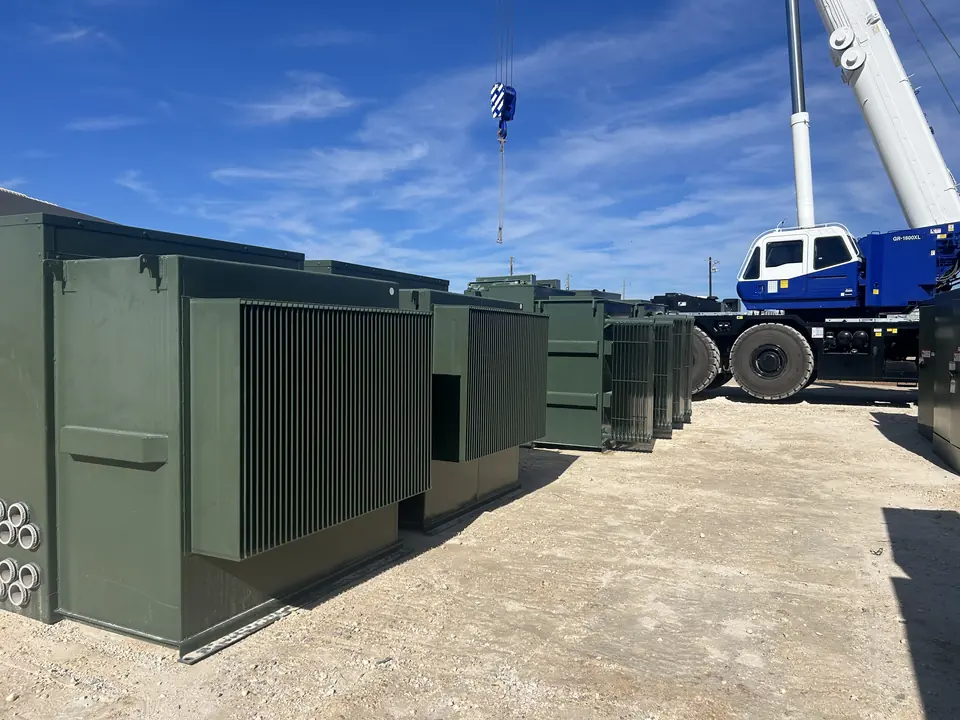
Sell a 300 kVA transformer, working or failed
We buy single transformers and whole lots, any brand, including equipment still in its crate and units removed after a failure. A used 300 kVA transformer does not have to be ready for immediate service for us to consider it. Tell us whether it is working, retired, damaged or untested.
Our yard and office are at 6402 McGrew St, Houston, TX 77087, and we buy statewide across Texas. Sellers include facility owners, electrical contractors, plant managers, developers, and utility or co-op staff. If a replacement project leaves you with several sizes, include the entire lot rather than separating the 300 kVA unit.
| Voltage | Full-load amps | Typical role |
|---|---|---|
| 208 V | 833 A | Low-voltage secondary |
| 240 V | 722 A | Low-voltage secondary |
| 480 V | 361 A | Low-voltage secondary |
| 600 V | 289 A | Low-voltage secondary |
| 12,470 V | 14 A | Distribution primary / secondary |
| 13,800 V | 13 A | Distribution primary / secondary |
| 24,940 V | 7 A | Distribution primary / secondary |
| 34,500 V | 5 A | Distribution primary / secondary |
Check any rating with the kVA to amps calculator.
What 300 kVA units look like and where they are used
At this size, three-phase padmount and dry-type units are common. The 300 kVA rating expresses apparent power capacity in kilovolt-amperes, not the amount of electricity the transformer uses. These units often serve apartment buildings, warehouses and small industrial facilities where three-phase distribution supports multiple loads.
A padmount generally has an outdoor, ground-level enclosure with separate connection compartments and an oil-filled tank. A dry-type uses air rather than insulating liquid and is often installed indoors or in a suitable protective enclosure. See our pages for padmount transformer sales and selling dry-type transformers for the broader equipment categories.
For a 300 kVA transformer in Texas, the building type alone does not establish its configuration. Apartment service may differ from warehouse or machine-shop service. Photos of the cabinet, terminals and nameplate help distinguish what you actually have.
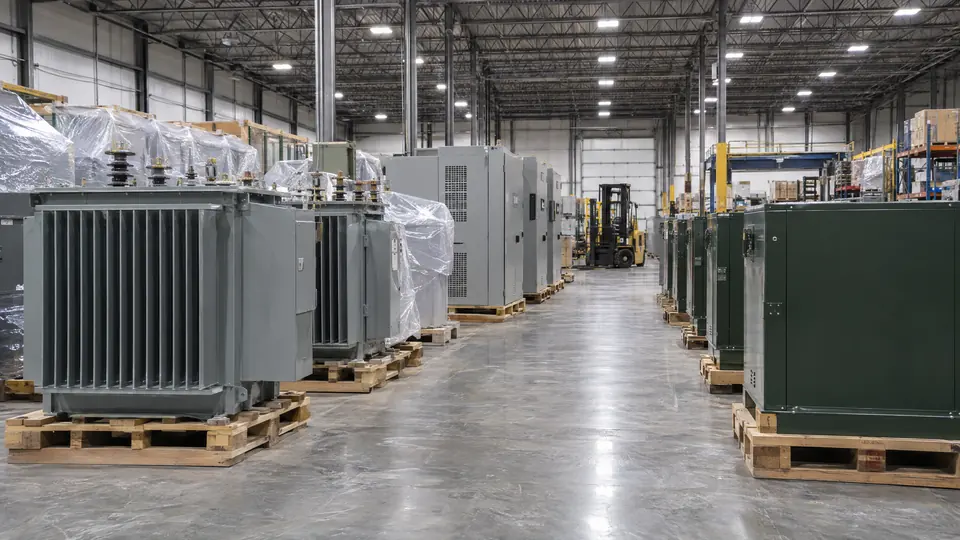
Voltage combinations and full-load amps
Common padmount combinations include a 12,470 V or 13,800 V primary supplying a 480Y/277 V or 208Y/120 V secondary. The primary is the incoming voltage; the secondary is the outgoing voltage. The Y indicates a wye connection, with the two secondary numbers identifying line-to-line and line-to-neutral voltage.
Systems using 24,940 V or 34,500 V distribution also use appropriately rated transformers. Dry-type units at this size commonly step 480 V down to 208Y/120 V, although other combinations exist. Send the actual ratings instead of assuming the voltage from the site service.
Three-phase full-load current is calculated as kVA × 1,000 ÷ (1.732 × line-to-line volts). For 300 kVA, that is approximately 833 A at 208 V, 361 A at 480 V and 289 A at 600 V. On a higher-voltage winding, it is approximately 14 A at 12,470 V, 13 A at 13,800 V, 7 A at 24,940 V and 5 A at 34,500 V.
The table below gives these reference values; our kVA-to-amps calculator and chart helps check other voltages. Buyers care because voltage and current affect compatibility with a potential installation. Full-load amps describe rated current, not measured load, breaker settings or proof that a unit is healthy.
What affects value and demand at 300 kVA
As a 300 kVA transformer buyer, we assess electrical configuration, condition and pickup requirements together. A usable voltage combination, complete enclosure and documented operating condition can affect the offer. Failed equipment needs a different assessment from clean surplus equipment that has never been installed.
Demand depends on matching a project, not capacity alone. This size can suit apartment distribution, warehouse loads and small industrial work, but a buyer still needs the right voltage, winding connection and installation type. A 300 kVA dry-type cannot automatically replace a 300 kVA padmount.
Useful details include tap settings, impedance and connection style. Impedance is the nameplate percentage that helps describe voltage drop and limits fault current. For padmounts, identify dead-front connections, which use insulated cable interfaces, and loop-feed arrangements, which provide connections for incoming and outgoing distribution cables.
Mention missing parts, leaks, corrosion, flood exposure or known winding damage. Available test reports and storage history help explain condition; they do not replace the basic photos. If your lot also includes 225 kVA transformers, send their plates too so each unit can be assessed on its own specifications.
Nameplate details and photos to send
Clear 300 kVA transformer specs make the assessment more useful than a description such as large green transformer. Photograph the complete plate straight on, close enough to read it. Our transformer nameplate guide explains where to find the main ratings.
Include these details when readable, plus overall photos showing every accessible side. Do not open energized compartments to obtain a better picture.
- Manufacturer, serial number, 300 kVA rating and three-phase designation.
- Primary and secondary voltages, winding connections, frequency, taps and impedance.
- Cooling designation, insulation information and listed weight.
- For liquid-filled units, insulating-fluid information and any PCB label or available records. PCB means polychlorinated biphenyls, a regulated substance historically used in some electrical equipment.
- Quantity, Texas location, operating status, known defects and whether the unit is installed, disconnected or stored.
Weight, rigging and trailer access
Do not estimate handling needs from the 300 kVA rating alone. Construction, enclosure and insulating medium affect weight and dimensions; check the nameplate for exact listed weights. Provide measured dimensions and available lifting information when planning removal.
Tell us whether the transformer is on a concrete pad, inside an electrical room, on a loading dock or already staged for freight. Door clearance, overhead obstructions, ground conditions and truck access can determine the rigging and trailer arrangement. Photos of the route out are useful alongside equipment photos.
The seller or the seller's qualified electrical contractor must de-energize and disconnect the equipment. We plan the trucking and loading with you ahead of pickup. Nothing is loaded until the price, payment terms and pickup plan are confirmed in writing.
Get an offer for your 300 kVA transformer
To sell a 300 kVA transformer, call or text (951) 403-5738, email Industrial832@gmail.com, or submit your transformer for an offer. Send the photos and details above, including any removal deadline or access restriction. We assess the information and respond with an offer.
You do not need a complete engineering file to start. A readable nameplate, clear overall photos and an accurate condition description give us a practical starting point.
Frequently asked questions
Will you consider a failed 300 kVA padmount?
Yes. We buy failed transformers as well as working units. Describe the failure and include any available test findings, damage photos and information about missing components.
Is 300 kVA enough to identify my transformer's output amps?
No. We also need voltage and phase. A three-phase 300 kVA unit is rated at approximately 361 A at 480 V, but approximately 833 A at 208 V.
Can I sell a 300 kVA dry-type still inside a building?
Yes, we can assess it for an offer. Send photos of the unit, doorway and removal route, along with the nameplate and location. Include any access restrictions that could affect load-out.
Does an unused 300 kVA transformer need condition photos?
Yes. Photograph the crate, enclosure and nameplate, and explain how it has been stored. Unused equipment can still have shipping damage, moisture exposure or missing accessories.
Can you buy my 300 kVA unit outside Houston?
Yes. We buy transformers anywhere in Texas and coordinate trucking and pickup from our Houston base. Provide the equipment location and site access details with your offer request.