Sell a 500 kVA transformer from your Texas facility
We buy single transformers and whole lots, any brand, whether still in a crate, operating before retirement, or failed. A 500 kVA unit may come from a retail redevelopment, hospital wing renovation, manufacturing plant upgrade or pump station replacement. You do not need a working transformer to request an offer.
Texas Transformer Buyers is based at 6402 McGrew St, Houston, TX 77087, and coordinates trucking and pickup across Texas. Tell us whether the unit is installed, disconnected, stored indoors or sitting outside. That starting point helps us understand both the equipment and the work needed to move it.
| Voltage | Full-load amps | Typical role |
|---|---|---|
| 208 V | 1,388 A | Low-voltage secondary |
| 240 V | 1,203 A | Low-voltage secondary |
| 480 V | 601 A | Low-voltage secondary |
| 600 V | 481 A | Low-voltage secondary |
| 12,470 V | 23 A | Distribution primary / secondary |
| 13,800 V | 21 A | Distribution primary / secondary |
| 24,940 V | 12 A | Distribution primary / secondary |
| 34,500 V | 8 A | Distribution primary / secondary |
Check any rating with the kVA to amps calculator.
Common 500 kVA configurations and applications
At this rating, three-phase padmounts, dry-type transformers and unit substations are common. kVA means kilovolt-amperes, the transformer's apparent-power rating; it is not a weight or a direct measure of usable kilowatts. The enclosure, voltage arrangement and cooling design matter just as much as the rating when identifying a unit.
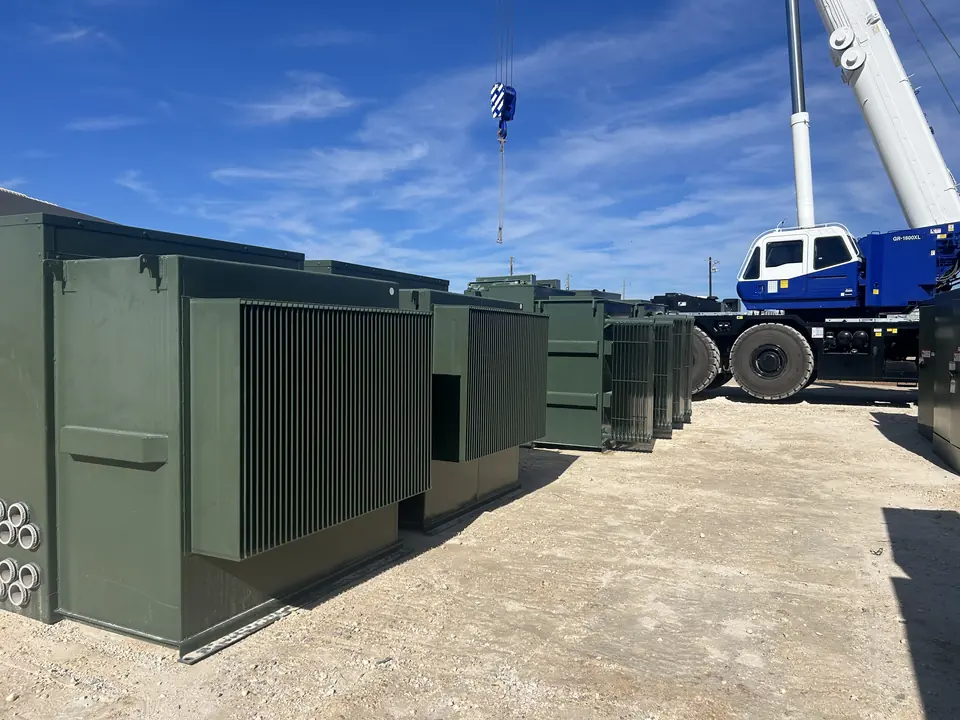
Padmount transformers usually have a ground-level enclosure with separate cable compartments and a liquid-filled tank. Dead-front construction uses insulated, shielded cable connections rather than exposed energized terminals. A loop-feed arrangement provides connections for incoming and outgoing distribution cables; photos help establish which arrangement you have.
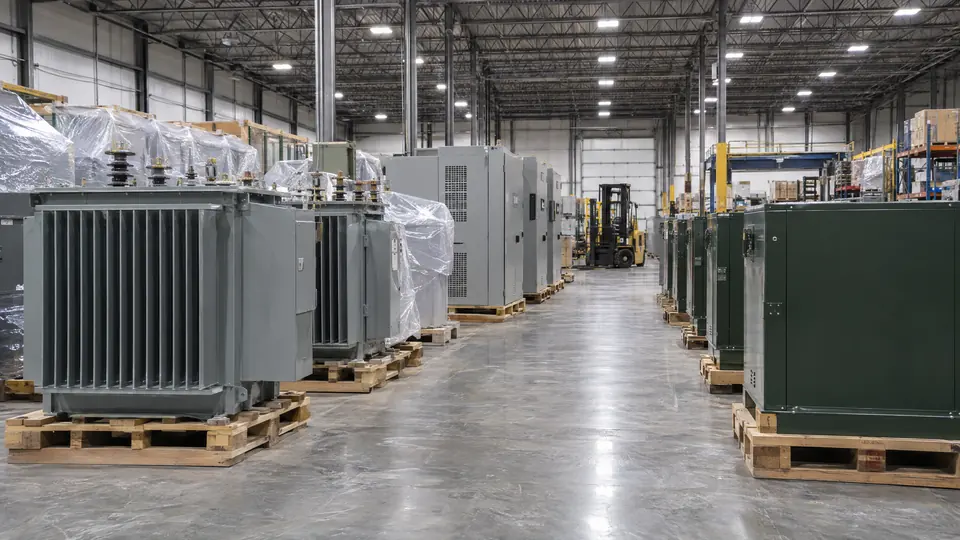
Dry-type transformers use air rather than insulating liquid and often serve indoor distribution loads. Unit substations combine a transformer with connected switching or distribution equipment. If yours is part of an assembly, show the entire lineup and identify which sections are included in the sale.
500 kVA transformer specs and voltage combinations
Common medium-voltage primary ratings include 12,470 V and 13,800 V, with 24,940 V or 34,500 V used on some distribution systems. The primary is the incoming supply side; the secondary supplies the connected load. Typical combinations include 12,470 V to 480Y/277 V and 13,800 V to 480Y/277 V.
A 208Y/120 V secondary serves lower-voltage distribution, while 600 V secondaries occur in some industrial installations. In a designation such as 480Y/277 V, Y identifies a wye connection: 480 V is measured between phases and 277 V from phase to neutral. Never identify voltage from the enclosure alone.
For a 500 kVA transformer in Texas, send the complete voltage markings, not just the nominal service voltage. Include tap settings, connection diagrams and impedance, the percentage measure of opposition to current flow that affects fault current and voltage regulation. These details help distinguish units with similar-looking cabinets but different electrical applications.
Full-load amps and what they tell a buyer
For three-phase equipment, full-load current equals kVA multiplied by 1,000, divided by 1.732 times the line-to-line voltage. At 500 kVA, that works out to approximately 1,388 A at 208 V, 601 A at 480 V and 481 A at 600 V. These are calculated rated-load currents, not measured operating readings.
On the higher-voltage side, the corresponding rounded values are 23 A at 12,470 V, 21 A at 13,800 V, 12 A at 24,940 V and 8 A at 34,500 V. The table below lays out these values, and the kVA-to-amps calculator helps compare other ratings and voltages.
Buyers care because current affects compatibility with secondary terminals, bus connections, cables and downstream equipment. The same 500 kVA rating produces very different current at 208 V and 480 V. Calculated amps do not establish conductor sizing, protective-device settings or the condition of the transformer.
What affects value and demand at this size
A 500 kVA transformer buyer needs to match the unit to a practical application. This size can serve substantial commercial loads and smaller industrial distribution systems, but demand depends on the voltage, construction and available documentation. A common configuration may fit more projects than a specialized unit.
Value also depends on age, condition, completeness, storage history and whether testing supports reuse. For a used 500 kVA transformer, explain why it was removed and whether it operated normally before removal. Missing covers, damaged bushings, leaks, corrosion or an incomplete substation assembly should be shown clearly.
Available test reports help explain condition. For liquid-filled units, DGA means dissolved gas analysis, which examines gases in insulating liquid for signs of internal problems. Send any available PCB documentation as well; PCB refers to polychlorinated biphenyls. We assess the actual equipment details rather than assigning a price from kVA alone.
Nameplate photos and records to send
Take a straight-on nameplate photo sharp enough to read without guessing. Our guide to reading a transformer nameplate shows where to find the identifying information. Include an overall view and close-ups of connection compartments, terminals and visible damage.
Send the following details together so we can assess the unit without relying on assumptions about its construction.
- Manufacturer, serial number, manufacture date if listed, 500 kVA rating, phase and frequency.
- Primary and secondary voltages, available taps, connection diagram, impedance and cooling designation.
- Quantity, Texas pickup location, condition, reason for removal and any available test or maintenance records.
- Photos of accessories and attached equipment, plus confirmation of what is included and what will remain onsite.
Plan load-out and request an offer
Weight varies by construction, enclosure and included equipment. Use the nameplate for exact listed weights rather than estimating from the 500 kVA rating. For a unit substation, distinguish transformer weight from the weight of the full assembly; include photos of any separate shipping-weight markings.
Show the pickup route, loading area, lifting points and any access restrictions. Rigging and trailer selection depend on actual weight, dimensions, center of gravity and available loading equipment. Indoor units may require planning around doorways, overhead clearance and the route to the loading area.
The unit has to be de-energized and disconnected by the seller or the seller's qualified electrician. We schedule the freight and load-out together with the seller. Nothing is loaded until the price, payment terms and pickup plan are confirmed in writing.
To sell a 500 kVA transformer, call or text (951) 403-5738, email Industrial832@gmail.com, or request an offer online. Submit the photos and details together; we assess them and respond with an offer.
Frequently asked questions
Can I sell a failed 500 kVA transformer?
Yes. We buy failed units as well as working equipment. Describe the failure, include photos of damage or leaks, and send any available testing records.
Is a 500 kVA dry-type worth the same as a padmount?
Not necessarily. Construction, voltage, condition, completeness and pickup requirements differ. Send the actual nameplate and photos so the offer reflects your unit rather than its rating alone.
Can I sell only the transformer from a unit substation?
We buy individual transformers. Identify which sections are included, show the assembly connections and explain how the transformer will be separated by the seller or qualified electrical contractor.
Does 601 amps mean my 480 V transformer was overloaded?
No. Approximately 601 A is the calculated three-phase full-load current at 480 V for 500 kVA. Determining past loading requires operating records, not the rating alone.
What if the 500 kVA nameplate is unreadable?
Send close-ups from several angles, overall photos and any purchase records, drawings or test reports. Identify uncertain details rather than guessing the voltage or connections.