How to use the transformer kVA to amps calculator
The calculator estimates rated full-load current, not the current a transformer draws at every moment. kVA means kilovolt-amperes, a measure of apparent power. Actual load current depends on the connected equipment and operating conditions.
Start with the transformer nameplate rather than a building’s service label or a nearby panel rating. Select the phase configuration, enter the rated kVA, and enter the voltage for the side you want to check. A kva calculator needs both capacity and voltage to produce a useful current result.
- Confirm whether the transformer is single-phase or three-phase.
- Enter capacity in kVA. Convert MVA, or megavolt-amperes, to kVA by multiplying by 1,000.
- Use primary voltage for incoming-side current or secondary voltage for outgoing-side current.
- For three-phase calculations, enter line-to-line voltage, measured between two phase conductors.
- Keep the unrounded result for calculations; round to whole amps when comparing the worked examples below.
kVA to amps calculator
Three-phase: amps = kVA × 1000 ÷ (1.732 × volts)
| kVA | 208 V | 240 V | 480 V | 600 V | 4,160 V | 12,470 V | 13,800 V |
|---|---|---|---|---|---|---|---|
| 45 kVA | 125 | 108 | 54 | 43 | 6 | 2 | 2 |
| 75 kVA | 208 | 180 | 90 | 72 | 10 | 3 | 3 |
| 112.5 kVA | 312 | 271 | 135 | 108 | 16 | 5 | 5 |
| 150 kVA | 416 | 361 | 180 | 144 | 21 | 7 | 6 |
| 225 kVA | 625 | 541 | 271 | 217 | 31 | 10 | 9 |
| 300 kVA | 833 | 722 | 361 | 289 | 42 | 14 | 13 |
| 500 kVA | 1,388 | 1,203 | 601 | 481 | 69 | 23 | 21 |
| 750 kVA | 2,082 | 1,804 | 902 | 722 | 104 | 35 | 31 |
| 1000 kVA | 2,776 | 2,406 | 1,203 | 962 | 139 | 46 | 42 |
| 1500 kVA | 4,164 | 3,608 | 1,804 | 1,443 | 208 | 69 | 63 |
| 2000 kVA | 5,551 | 4,811 | 2,406 | 1,925 | 278 | 93 | 84 |
| 2500 kVA | 6,939 | 6,014 | 3,007 | 2,406 | 347 | 116 | 105 |
| 3000 kVA | 8,327 | 7,217 | 3,608 | 2,887 | 416 | 139 | 126 |
| 3750 kVA | 10,409 | 9,021 | 4,511 | 3,608 | 520 | 174 | 157 |
| 5000 kVA | 13,879 | 12,028 | 6,014 | 4,811 | 694 | 231 | 209 |
Three-phase kVA to amps formula
For a three-phase transformer, amps = kVA × 1,000 ÷ (1.732 × volts). The factor 1.732 approximates the square root of three. Use the transformer’s total three-phase kVA rating and its line-to-line voltage; the result is rated line current.
For a 480Y/277 V secondary, use 480 V in this formula, not 277 V. The 277 V value is line-to-neutral voltage. Using it with the three-phase formula would overstate the calculated line current.
For 3 phase kva to amps conversion, do not divide total nameplate kVA by three before entering it. The formula already accounts for the three-phase relationship. If you are evaluating a bank of individual single-phase transformers, first establish the bank’s total rating and connection.
- Three-phase current: A = kVA × 1,000 ÷ (1.732 × V).
- Reverse calculation: kVA = 1.732 × V × A ÷ 1,000.
- Use the same winding’s voltage and current together when checking a rating.
Single-phase kVA to amps formula
For a single-phase transformer, amps = kVA × 1,000 ÷ volts. There is no 1.732 factor. Use the rated voltage across the winding or terminals whose full-load current you are calculating.
A 50 kVA transformer at 240 V single-phase gives 50 × 1,000 ÷ 240 = 208.3 A, or approximately 208 A. This is the rated current at 240 V, not an allowance to place the entire rating on one leg of a 120/240 V service.
Center-tapped windings need particular care. A center tap provides a neutral connection between two winding halves, and loading one half is not equivalent to balanced loading across the full winding. Check the nameplate and connection diagram before using a 120 V entry to estimate available current.
- Single-phase current: A = kVA × 1,000 ÷ V.
- Reverse calculation: kVA = V × A ÷ 1,000.
- Do not choose the phase setting based only on how many terminals are visible.
Worked examples at 480 V and 208 V
At the same kVA rating, a lower voltage means a higher full-load current. That relationship matters when comparing transformers for different services: equal capacity does not mean equal amperage.
The examples below use rated three-phase capacity and line-to-line voltage. Results are rounded to the nearest amp, so a calculator using the full square-root-of-three value may show slightly different decimal results.
- 1,500 kVA at 480 V: 1,500 × 1,000 ÷ (1.732 × 480) = approximately 1,804 A.
- 500 kVA at 208 V: 500 × 1,000 ÷ (1.732 × 208) = approximately 1,388 A.
- 75 kVA at 480 V: 75 × 1,000 ÷ (1.732 × 480) = approximately 90 A.
- For comparison, 75 kVA at 208 V: 75 × 1,000 ÷ (1.732 × 208) = approximately 208 A.
Read the chart for primary and secondary amps
Use the transformer full load amps chart by locating the kVA row, then finding the voltage column for the correct phase configuration. Check the chart’s phase label before reading a value. A three-phase chart cannot be used directly for a single-phase unit.
Primary means the incoming supply winding; secondary means the outgoing load winding. Calculate each side separately using its own rated voltage. For example, a 500 kVA three-phase transformer rated 12,470 V primary and 480 V secondary has approximately 23 A primary current and 601 A secondary current.
Those different currents represent approximately the same rated apparent power at different voltages. The basic calculation does not model losses, excitation current, or overload performance. If the nameplate lists winding currents, compare those values with the chart and investigate any substantial mismatch.
- Read the complete voltage designation, including any listed taps or alternate connections.
- Confirm that the selected kVA applies to the operating configuration being checked.
- Record primary and secondary results separately rather than labeling either one simply transformer amps.
- If the chart lacks your voltage or kVA, use the formula instead of the nearest row.
Standard kVA sizes and what the rating means
Common single-phase ratings include 10, 15, 25, 37.5, 50, 75, and 100 kVA. Common three-phase ratings include 45, 75, 112.5, 150, 225, 300, 500, 750, 1,000, 1,500, 2,000, and 2,500 kVA. Availability varies by transformer type and application; these lists are not exhaustive.
Larger substation and power transformers may carry MVA ratings. For calculator purposes, 1.5 MVA equals 1,500 kVA. Some units list multiple capacities associated with different cooling arrangements, so identify the applicable rating before calculating current.
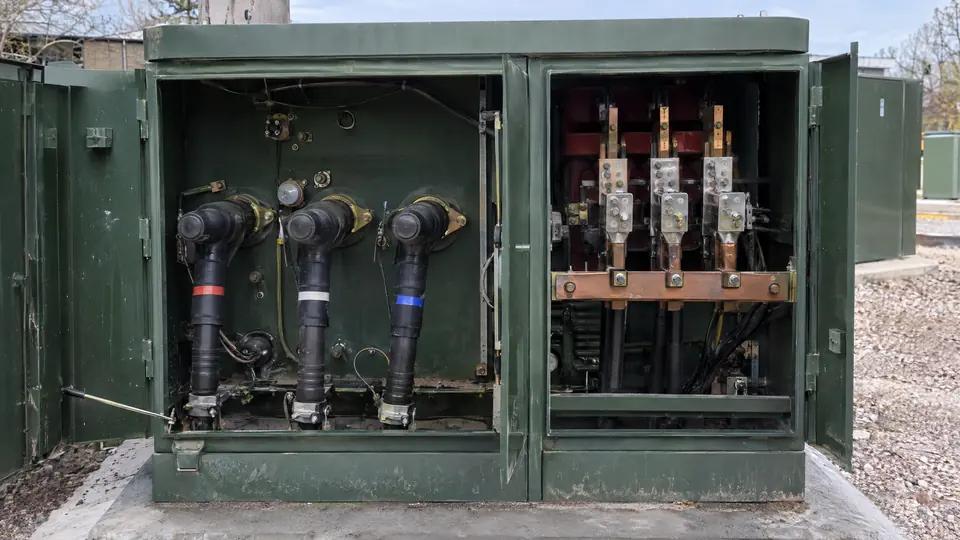
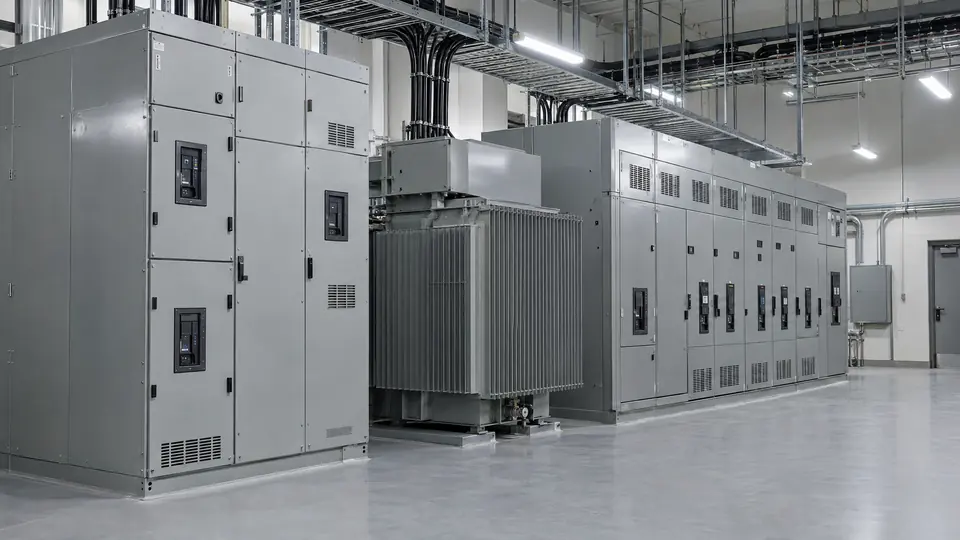
Physical construction does not change the basic conversion formula. However, it matters when identifying equipment: compare padmount and substation configurations and dry-type versus oil-filled construction when assembling a complete equipment description.
- Use the actual nameplate rating, not an estimate based on enclosure dimensions.
- Record all listed capacities if the nameplate shows more than one cooling rating.
- Keep fractional ratings such as 37.5 or 112.5 kVA intact when entering them.
Use full-load amps for comparison, not complete sizing
Full-load amps help establish whether a transformer’s voltage and capacity fit a prospective service. A buyer evaluating a 480 V facility needs different current information than one evaluating a 208 V service, even when both transformers carry the same kVA rating.
Transformer sizing requires more than this conversion. Load demand, continuous loads, motor starting, harmonics, ambient conditions, and applicable electrical requirements can affect selection. Full-load current alone does not establish conductor size, breaker size, or a permissible loading plan.
When selling, accurate ratings help a buyer assess electrical compatibility before discussing logistics. Include phase, both voltages, capacity, and impedance—the transformer’s opposition to current flow, usually shown as a percentage—which affects voltage regulation and available fault current.
- Photograph the entire nameplate so voltage, phase, kVA, and impedance remain readable.
- Include overall views, terminals or connection compartments, and visible damage without opening energized equipment.
- Identify whether the unit is working, retired, failed, or of unknown operating condition.
- Describe access and handling constraints; the guide to moving transformers in Texas can help organize logistics information.
Send transformer details for a purchase offer
Texas Transformer Buyers buys single units and whole lots statewide, any brand, from 10 kVA pole-mounts to large MVA substation and power transformers. New-in-crate, used, working, retired, and failed equipment can be submitted. Review the transformer sizes we buy alongside your nameplate details.
Use the transformer kVA to amps calculator to understand the rating, then send a nameplate photo, overall photos, quantity, location, and condition. Call or text (951) 403-5738, email Industrial832@gmail.com, or request an offer on your transformer. We review the details and respond with an offer.
Our yard and office are at 6402 McGrew St, Houston, TX 77087, and we coordinate trucking and pickup across Texas. Price, payment terms, and pickup details are agreed in writing before loading. The seller or the seller’s qualified electrical contractor must de-energize and disconnect equipment; we coordinate freight and load-out with the seller.
- For water exposure or storm damage, include photos and a description of the event; see selling storm- or flood-damaged transformers.
Frequently asked questions
Does full-load amps mean the transformer always draws that current?
No. Full-load amps describe current at rated capacity and voltage. Actual current varies with the connected load, and an energized transformer also draws excitation current without a connected load.
Should I enter 208 V or 120 V for a 208Y/120 V transformer?
Enter 208 V for the three-phase calculation. That is the line-to-line voltage. The 120 V value describes line-to-neutral voltage and is not the voltage input for this formula.
Can I convert kW directly to transformer amps?
Not without additional information. kW measures real power, while kVA measures apparent power. You need power factor to convert kW to kVA, then phase and voltage to calculate current.
Why are primary amps lower than secondary amps?
On a step-down transformer, primary voltage is higher, so primary current is lower for approximately the same apparent power. Calculate each winding’s rated current using its own voltage.
Can this calculator determine my breaker size?
No. It supplies a full-load current reference. Protective-device selection also depends on installation requirements, transformer inrush, conductor protection, and applicable electrical rules.
What if the nameplate is unreadable?
Do not infer capacity from calculated amps or enclosure size alone. Gather equipment records, drawings, and any readable labels. Photograph the damaged plate and document which ratings remain unknown.