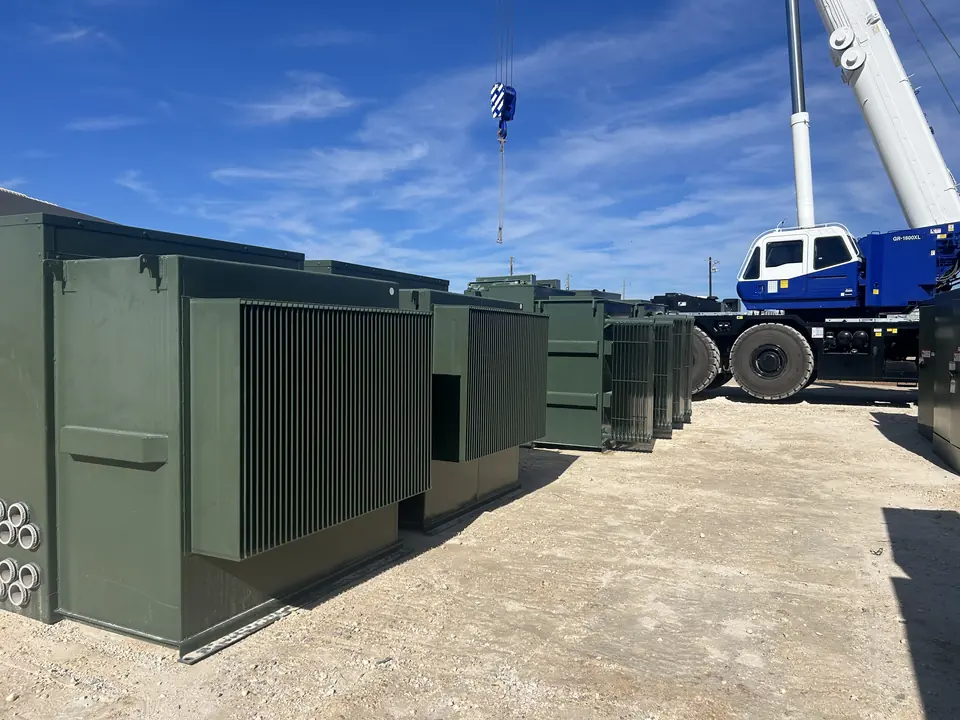
Padmount transformer buyers for single units and whole lots
We buy padmount transformers in any brand, whether you have one unit left from a project or a whole lot removed during a facility upgrade. The typical three-phase range covered here is 75 kVA to 5,000 kVA. kVA means kilovolt-amperes, the nameplate rating for apparent power; 1,000 kVA equals 1 MVA, or megavolt-ampere.
New equipment still in its crate, installed working units, retired equipment and failed transformers are all worth submitting for an offer. Tell us what you know about each unit rather than waiting until every record is assembled. If several transformers differ in voltage, rating or condition, identify them separately so the offer can reflect the lot accurately.
Our yard and office are at 6402 McGrew St, Houston, TX 77087, and we buy across Texas. For a project close to our base, see our Houston transformer buying page. You do not need to bring the equipment to Houston to start the process; we coordinate trucking and pickup with the seller.
Padmount transformers sizes we buy
- 75 kVA
- 150 kVA
- 225 kVA
- 300 kVA
- 500 kVA
- 750 kVA
- 1000 kVA (1 MVA)
- 1500 kVA
- 2000 kVA (2 MVA)
- 2500 kVA
- 3000 kVA (3 MVA)
- 3750 kVA
- 5000 kVA (5 MVA)
Identify a three-phase pad-mounted transformer
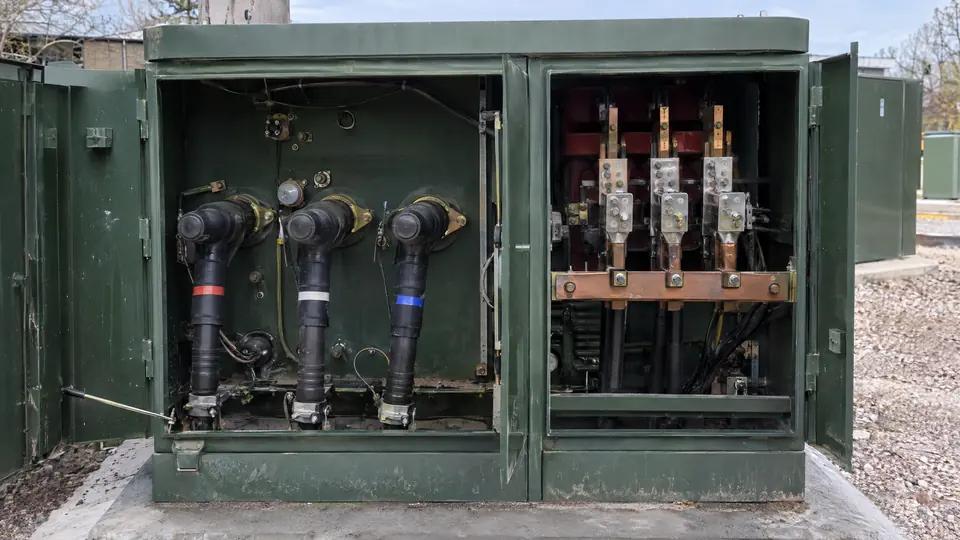
A three-phase padmount transformer has a tamper-resistant steel cabinet set on a concrete pad. Separate high-voltage and low-voltage compartments sit behind locking doors. The nameplate identifies the phase count, power rating and electrical configuration; cabinet appearance alone is not enough to confirm exactly what you have.
Dead-front units use load-break elbows and bushing wells for the high-voltage connections. Live-front units have exposed bushings inside the cabinet. These terms describe the connection arrangement, not permission to open or handle energized equipment. Send existing records or photos taken when qualified personnel can safely access the compartments.
A similar-looking residential unit may be single-phase rather than three-phase; use our single-phase padmount page for that equipment. A transformer connected as part of an integrated switchgear and distribution assembly may instead belong on our unit substation page. Photos of the complete installation help distinguish the equipment and show what is included.
Ratings, voltages and configurations we buy
Send units rated 75, 150, 225, 300, 500, 750, 1,000, 1,500, 2,000, 2,500, 3,000, 3,750 or 5,000 kVA for an offer. That list covers common sizes, not a requirement to fit one exact rating. For smaller three-phase equipment, our 75 kVA transformer page provides another relevant starting point.
Primary voltage is the incoming supply voltage; secondary voltage is the outgoing utilization voltage. Common Texas primaries include 12,470Y/7,200 V, 13,200 V, 13,800 V, 24,940Y/14,400 V and 34,500 V. Common secondaries are 208Y/120 V and 480Y/277 V. Include the full markings, including the Y and both listed voltage values, rather than shortening them.
Identify whether the primary arrangement is radial-feed or loop-feed. Loop-feed units often have two- or four-position load-break switches. These transformers may contain mineral oil or a less-flammable natural ester fluid, with protection that includes bay-o-net fuses and current-limiting fuses. Three-phase pad-mounted distribution transformers are built to IEEE C57.12.34; send any standard designation shown on your unit's nameplate.
New surplus, used, retired and failed equipment
Unused transformers can become available after a canceled development, revised service design or change in a project's required voltage. Include storage history, crate condition and any factory paperwork for those units. Our new surplus transformer buying page covers equipment that never entered service.
Used padmount transformers in Texas can come from plant expansions, service upgrades, building demolition and equipment replacement. Facility owners, electrical contractors, utility and co-op staff, developers and oilfield operators may have units to sell. Relevant projects can be in Houston, Pasadena, Baytown, La Porte, Pearland, Sugar Land, Katy or The Woodlands, as well as elsewhere statewide.
Retired does not necessarily mean failed, and failed does not mean we cannot consider it. Describe why the transformer was removed and whether the problem involved fuses, connections, leakage or an internal fault. For a unit still installed, tell us its current service status and expected availability so we can discuss pickup around your removal schedule.
What drives the offer on your padmount transformer
As padmount transformer buyers, we evaluate the equipment's rating, primary and secondary voltages, age, brand and reported condition together. A larger rating alone does not determine the offer. Electrical configuration, completeness and available records help establish what the unit is and how it may fit another application.
Useful records include factory tests, maintenance history and recent electrical or oil test reports. DGA means dissolved gas analysis, an oil test that can help assess internal operating conditions. PCB means polychlorinated biphenyls; provide any fluid labels or laboratory records establishing PCB status. Do not substitute an assumption based only on age for documented fluid information.
Photograph switches, fuses, elbows and other included accessories, and identify anything missing. Quantity, location and load-out access also affect the evaluation because they determine the handling and freight requirements. Note restricted gates, soft ground, overhead obstructions or equipment inside a fenced enclosure. Our guide to used transformer value explains the information that supports an evaluation.
What to send when you want to sell a padmount transformer
Start with readable photos and a short equipment summary. You do not need to rewrite the entire nameplate if a clear image captures it, but flag markings that are damaged or unreadable. Our transformer nameplate guide can help you locate the identifying information.
For a mixed lot, label each unit's photos with the same identifier used in your list. This keeps ratings, condition notes and quantities connected to the correct equipment. Send the following details together when available.
- A clear nameplate photo showing brand, serial number, year, kVA rating, primary and secondary voltage, impedance and listed weight. Impedance is the transformer’s electrical opposition, commonly stated as a percentage.
- Overall photos from several sides, including cabinet condition, doors, visible damage and the installation or storage area.
- Quantity and condition for each unit: new surplus, used working, retired or failed, with any known faults, leaks or missing components.
- The Texas pickup location, your contact information, current connection status and the date or project stage when equipment will be available.
- Available test reports, fluid and PCB records, accessory details, and photos or notes describing truck access and loading arrangements.
Pickup, freight and load-out planning
The seller, or the seller's qualified electrical contractor, must de-energize and disconnect the equipment. We work out trucking and load-out with you. Describe whether the transformer remains on its pad, has already been moved to storage or is accessible to lifting equipment.
Use the nameplate weight or manufacturer documentation for planning rather than estimating weight from kVA alone. Share the available lifting equipment, loading surface, gate clearance and any site restrictions. If loading resources have not been arranged, say so when submitting your details so those arrangements can be addressed before a truck is scheduled.
We confirm the price, how payment is made and the pickup arrangements in writing before loading starts. The written arrangement should identify the equipment being sold and the agreed load-out plan. For multiple units, make sure the pickup list matches the photos and condition information provided for the offer.
Send your equipment details for an offer
If you need a pad-mounted transformer buyer for a Texas project, call or text (951) 403-5738, email Industrial832@gmail.com, or submit your transformer for an offer. Send the nameplate photo, overall photos, quantity, location and condition. We evaluate the details and respond with an offer.
For equipment still serving a facility, include the planned outage or replacement schedule. For stored units, include their present location and access conditions. Those details let us discuss the equipment and transportation together without overlooking what must happen before pickup.
Frequently asked questions
Do you buy padmount transformers with blown fuses or missing elbows?
Yes, we consider failed and incomplete units. Identify the blown fuses, missing elbows or other known issues, and include photos where safely available. Describe any diagnosis separately from symptoms so we know whether the cause was confirmed or remains unknown.
Can I sell a unit without test reports?
Yes. Send the nameplate, overall photos and known condition even if test reports are unavailable. Tell us which records you have and which are missing. Reports can support the evaluation, but you can start the offer process without them.
How heavy is a three-phase pad-mounted transformer?
Weight varies by rating, design, cabinet and fluid volume. Use the nameplate's listed weight or manufacturer documentation for your specific unit. Send that information with the photos so freight and lifting requirements can be discussed using the actual equipment details.
Will you buy a transformer that is still connected?
You can submit an installed unit for an offer before removal. Include its operating condition and planned availability. De-energizing and disconnecting must be completed by the seller or the seller's qualified electrical contractor before the equipment is loaded for pickup.
Do you buy one transformer, or only larger lots?
We buy single units and whole lots. For a single transformer, send its photos and details. For a lot, provide a unit-by-unit list so different ratings, voltages and conditions are clear, along with the location and access information for each pickup site.