Sell a 75 kVA transformer from your Texas facility
We buy single transformers and whole lots, any brand, whether new in a crate, still installed, stored after replacement or failed in service. Our yard and office are at 6402 McGrew St, Houston, TX 77087, and we coordinate trucking and pickup across Texas.
At this size, equipment often comes from retail suites, small offices, shop buildings and well pads. A tenant renovation, service upgrade, plant consolidation or oilfield project change can leave a transformer available even when it still works.
You do not need a complete maintenance file to start the conversation. If you are clearing a site, identify each unit separately and show whether it is installed, disconnected or already staged for loading.
| Voltage | Full-load amps | Typical role |
|---|---|---|
| 208 V | 208 A | Low-voltage secondary |
| 240 V | 180 A | Low-voltage secondary |
| 480 V | 90 A | Low-voltage secondary |
| 600 V | 72 A | Low-voltage secondary |
| 12,470 V | 3 A | Distribution primary / secondary |
| 13,800 V | 3 A | Distribution primary / secondary |
| 24,940 V | 2 A | Distribution primary / secondary |
| 34,500 V | 1 A | Distribution primary / secondary |
Check any rating with the kVA to amps calculator.
What a 75 kVA unit usually looks like
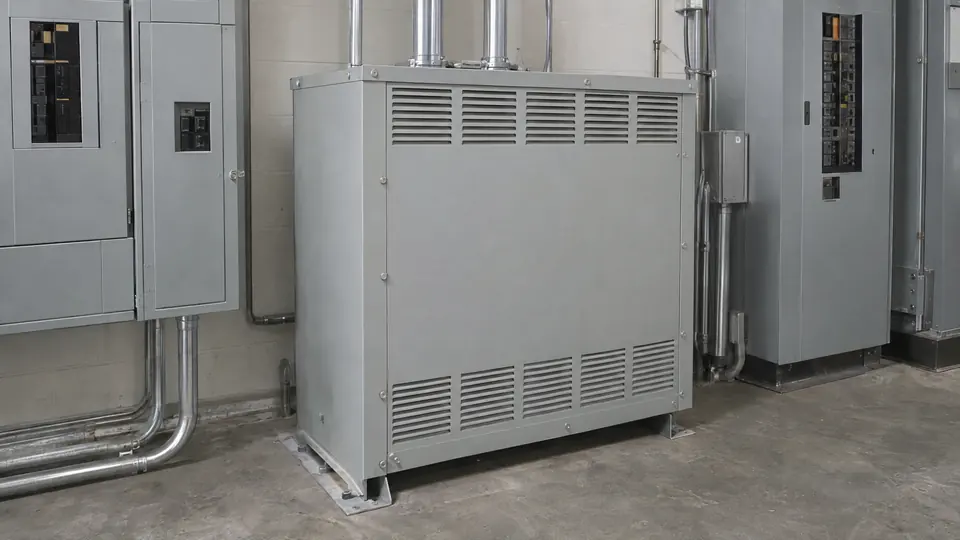
A common indoor version is a three-phase dry-type transformer: its windings use air rather than insulating liquid for cooling. These units typically have a ventilated metal enclosure and may sit on a floor, platform or other approved support near the loads they serve.
Our dry-type transformer buying page covers this equipment category. Exterior photos should show the enclosure, ventilation openings and any visible corrosion or impact damage; interior photos can help when safely available.
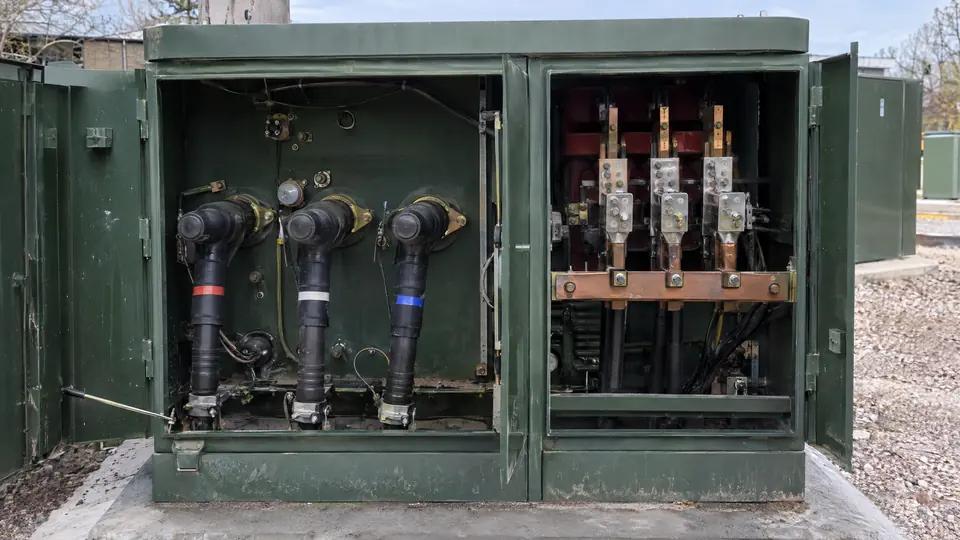
Another common form is a three-phase padmount transformer, usually an outdoor, liquid-filled unit with a locked cabinet containing cable connections. Dead-front construction means energized connections are shielded by insulated connectors; loop-feed means the primary arrangement accommodates incoming and outgoing cables. See our padmount transformer information for that configuration.
The enclosure alone does not establish the rating or connection arrangement. A clear nameplate and connection diagram help distinguish otherwise similar-looking units.
75 kVA transformer specs and common voltages
Primary voltage is the supply entering the transformer; secondary voltage is the output feeding the load. A common dry-type arrangement is 480 V primary to 208Y/120 V secondary, where the Y identifies a wye connection providing 208 V between phases and 120 V from phase to neutral.
Other configurations can include 480 V to 240 V or equipment designed for a 600 V supply. Three-phase padmount units may take distribution voltage such as 12,470 V or 13,800 V and supply 208Y/120 V or 480Y/277 V. Higher primary ratings also occur, so send the actual plate rather than estimating from the installation.
A 75 kVA transformer buyer needs the voltage, phase and connection details together. Frequency, tap settings and impedance—the transformer's opposition to current flow, expressed as a percentage—also matter when assessing compatibility with a prospective application.
Full-load amps and why buyers check them
The 75 kVA rating describes apparent power capacity, not a fixed amperage. For three-phase equipment, full-load current equals kVA multiplied by 1,000, divided by 1.732 times the line-to-line voltage. Lower voltage means higher current for the same capacity.
The table below shows approximate three-phase full-load currents: 208 A at 208 V, 90 A at 480 V and 72 A at 600 V. On the distribution-voltage side, the rounded figures are 3 A at 12,470 V, 3 A at 13,800 V, 2 A at 24,940 V and 1 A at 34,500 V.
Buyers check these figures to understand the intended load and connections, not to substitute for electrical design. Our kVA-to-amps calculator and chart helps compare voltages. The transformer's actual nameplate, protective devices and installation requirements remain important when evaluating reuse.
What affects value and demand at this size
Demand for this size comes from applications needing modest three-phase capacity, including commercial tenant spaces, workshops and support buildings. Matching the available unit to the required voltage and enclosure is more important than the 75 kVA rating alone.
A used 75 kVA transformer with a readable plate, complete connections and documented operating condition gives a buyer more information to evaluate. New surplus condition, storage history, missing parts, winding damage, enclosure corrosion and signs of overheating all affect the assessment.
For liquid-filled equipment, report leaks and share available fluid test records. If records identify PCB content—polychlorinated biphenyls formerly used in some insulating fluids—include that documentation rather than guessing. Working and failed units are both within our buying scope.
Quantity, access and freight requirements also affect an offer. If a replacement project leaves mixed sizes available, include the 45 kVA units and 112.5 kVA units in the same equipment list.
Nameplate photos and load-out information to send
Photograph the complete nameplate straight on, with enough resolution to read small lettering. Our guide to reading a transformer nameplate helps locate rating and connection information. Include overall views from several sides and close-ups of damage or missing components.
For weight, check the nameplate for the exact listed weight rather than relying on a typical figure for this size. Enclosure style and construction affect handling, and a dry-type unit should not be assumed to weigh the same as a liquid-filled padmount.
- Send manufacturer, serial number, 75 kVA rating, phase, frequency, primary and secondary voltages, taps and impedance.
- Identify condition, quantity and Texas pickup location, plus any available test records or history of failure.
- Describe stairs, doorways, overhead clearance, dock access, ground conditions and available lifting equipment.
- Show the loading area so rigging, trailer access and securement can be planned around the actual equipment.
Get an offer and arrange pickup
To sell a 75 kVA transformer, call or text (951) 403-5738, email Industrial832@gmail.com, or submit your transformer for an offer. We evaluate the details and respond with an offer. Include all units if you want an offer on the whole lot.
Nothing is loaded until the price, payment terms and pickup plan are confirmed in writing. The seller or the seller's qualified electrical contractor must de-energize and disconnect the equipment; we coordinate freight and load-out with the seller.
Tell us whether you have a forklift, crane access or a loading dock, and whether the transformer must be moved out of a building first. Those details help establish a practical pickup plan without assuming that a standard trailer or lifting arrangement will suit every site.
Frequently asked questions
Can I sell a failed 75 kVA transformer?
Yes. We buy failed units as well as working equipment. Describe the failure, identify any leaks or visible damage, and send available test results with the photos.
Does 75 kVA mean the transformer supplies 75 kW?
Not necessarily. kVA measures apparent power; kW measures real power. The relationship depends on the load's power factor, so buyers use the nameplate rating and application details together.
Do you buy 75 kVA transformers outside Houston?
Yes. For a 75 kVA transformer in Texas, send the city and site location. We buy statewide and coordinate trucking and pickup from our Houston base.
Can you make an offer on a 75 kVA unit still installed?
Yes. Send accessible nameplate and overall photos without opening energized equipment. Identify its current status and the expected removal plan so pickup arrangements can reflect the site conditions.
What if the nameplate on my 75 kVA unit is unreadable?
Send the clearest photos available, including any separate connection diagram, labels and records. Identify the rating as unconfirmed if you cannot verify it; do not infer voltage from enclosure appearance.