How to read a transformer nameplate safely
The nameplate summarizes the transformer's design ratings, not its present condition. It cannot prove that a used unit operates correctly, has clean insulating liquid or suits a particular installation. Those questions require records, testing or assessment by a qualified electrical professional.
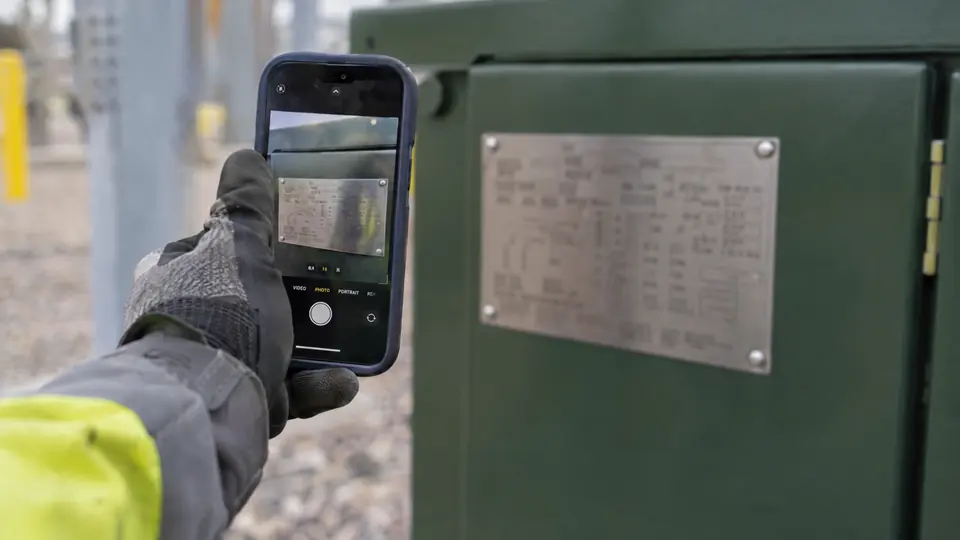
Read only plates accessible without entering energized compartments or removing protective barriers. Photograph the entire plate straight on, then take close-ups of faint fields. Glare often hides stamped numbers, so adjust the camera angle rather than reaching into equipment.
- Capture every plate, including separate connection, cooling and accessory plates.
- Copy units exactly: kVA, MVA, volts, amperes, percent, gallons and pounds are not interchangeable.
- Record missing or unreadable fields as unknown rather than guessing.
- Use the transformer photo checklist to document the plate and overall equipment.
Manufacturer, serial number and manufacture date
Start with the manufacturer, serial number and any catalog or type designation. The serial number identifies an individual transformer and helps match it to factory drawings, test reports and maintenance records. Keep letters, hyphens and leading zeros when transcribing it.
Look for an explicit manufacture date rather than inferring age from appearance. When checking the transformer serial number year against manufacturer records, remember that there is no universal date code. A repair or rewind date is not necessarily the original manufacture date.
If the unit was rebuilt, photograph both the original and replacement plates. Note which ratings each plate shows; do not combine them into a single assumed specification. Resolve conflicting information against the rebuild documentation.
kVA or MVA rating and cooling class
The transformer nameplate kVA rating states apparent-power capacity in kilovolt-amperes; MVA means megavolt-amperes, with 1 MVA equal to 1,000 kVA. This is not a direct statement of usable kilowatts, which also depend on the load's power factor.
Read capacity together with cooling class. ONAN means oil natural, air natural: liquid and surrounding air circulate without forced cooling. ONAF means oil natural, air forced, with fans moving air across cooling surfaces. Multiple ratings may correspond to different cooling stages.
Do not assume the highest listed rating is available if required fans, controls or other cooling equipment are missing or inoperative. Dry-type units use different cooling designations, commonly AA for air-cooled and FA for fan-assisted ratings on US equipment. For current calculations, use the kVA-to-amps guide with the correct voltage and phase.
- Record every capacity rating and its associated cooling designation.
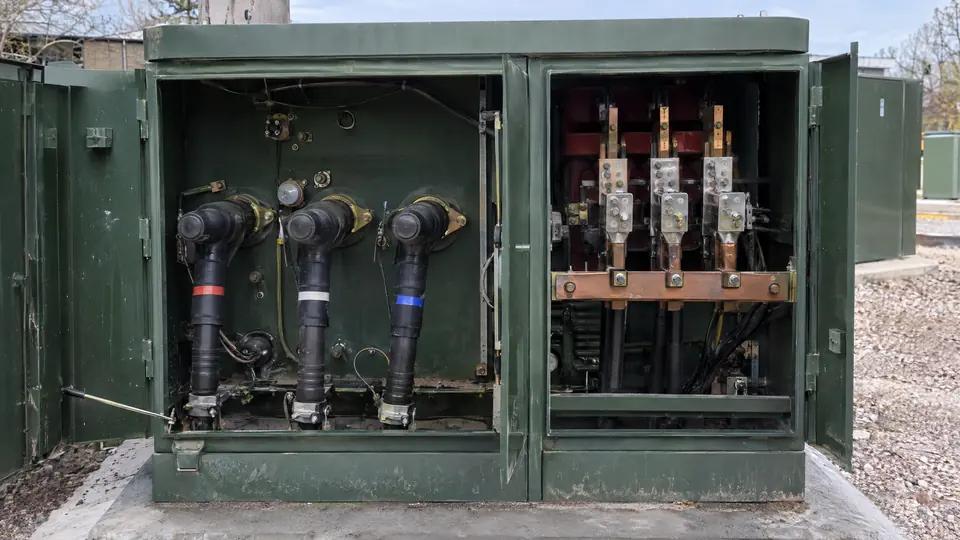
- Photograph radiators, fans and cooling-control cabinets where accessible.
- Check whether the plate lists rated current separately for each winding.
Primary and secondary voltages and tap settings
Primary voltage is the rated input-side voltage; secondary voltage is the rated output-side voltage in the intended application. Plates may instead identify high-voltage and low-voltage windings as HV and LV. Record the complete voltage notation, including any grounded-wye designation.
A marking such as 480Y/277 indicates 480 volts between phases and 277 volts from phase to neutral on a wye-connected winding. Do not treat those as two independent output ratings. On many three-phase plates, the main voltage rating is line-to-line.
Taps are winding connection points that adjust the voltage ratio. List the available tap voltages and photograph the indicated position if safely visible. A de-energized tap changer must not be operated while energized; a load tap changer is a different system designed for adjustment under specified operating conditions.
- Separate rated voltage from the tap position currently indicated.
- Record dual-voltage options and the connection required for each.
- Do not assume a selectable voltage configuration is already connected that way.
Phase, frequency, winding connection and vector group
Check whether the unit is single-phase or three-phase and record frequency in hertz, usually 60 Hz for US power systems. Matching voltage alone does not establish suitability for another frequency. Frequency changes affect core flux and require engineering assessment.
Winding connections commonly include delta and wye. Delta connects three windings in a closed triangle; wye joins one end of each winding at a common point, which may be brought out as a neutral. The connection diagram shows terminal relationships and available neutral connections.
A vector group, commonly found on IEC-style plates, describes winding connections and phase displacement. Clock notation expresses displacement in 30-degree steps. North American plates may instead provide a connection diagram and angular displacement; use that information rather than assuming a vector group.
For parallel operation, connection and phase displacement must be compatible along with other electrical characteristics. Equipment layout is a separate issue: the padmount and substation comparison explains those physical configurations.
Impedance percentage and what it tells you
Percent impedance describes the voltage, expressed as a percentage of rated voltage, needed to circulate rated current during a short-circuit test with the other winding shorted. It affects voltage regulation and the current a transformer can supply into a fault.
Lower impedance generally permits more fault current when capacity and voltage are otherwise equal. A simplified estimate uses rated current divided by impedance expressed as a decimal, but actual available fault current also depends on the upstream source and circuit impedance.
Record the impedance value together with its stated kVA base, tap and reference temperature when provided. These details matter when comparing units, especially transformers considered for parallel service. Matching kVA and voltage does not make two transformers interchangeable.
Insulating liquid, gallons and shipping weights
Liquid-filled plates may identify mineral oil, natural ester, synthetic ester or another insulating fluid. Record the exact wording and liquid quantity. Gallons describe fluid volume, not transformer capacity, and they should not be converted into total equipment weight.
Distinguish total weight, untanking weight, core-and-coil weight and shipping weight where listed. Shipping weight may reflect a specific shipping configuration, including whether liquid or accessories are installed. Freight planning also needs dimensions and confirmation of which components remain attached.
A fluid description or manufacture date alone does not establish PCB status. PCB means polychlorinated biphenyls, chemicals historically associated with some electrical insulating liquids. Keep labels and available laboratory reports with the equipment; the PCB labels and oil-testing guide explains what to document.
- Photograph liquid labels, sample records and separate weight plates.
- Note visible leaks and whether radiators or other accessories are detached.
- For dry-type equipment, record enclosure and total weight rather than looking for an oil quantity.
Temperature rise, BIL and listed standards
Temperature rise describes the permitted increase above the specified ambient temperature under defined rating conditions. A 65°C rise is not a 65°C maximum operating temperature. Liquid-filled and dry-type plates may list different thermal details, including winding rise and insulation class.
BIL means basic lightning impulse insulation level. It expresses impulse withstand capability in kilovolts, not normal operating voltage. Record BIL for each winding when shown; the high-voltage and low-voltage sides can have different values.
Listed IEEE, ANSI or IEC standards identify the design or testing framework referenced by the manufacturer. They do not establish present condition. Gather factory test reports and maintenance records, including DGA—dissolved gas analysis of insulating liquid—when available, without treating one test result as a complete condition assessment.
Send nameplate details for a transformer offer
Texas Transformer Buyers buys single units or whole lots, any brand, new in crate or used, working or failed, from 10 kVA pole-mounts to large MVA substation and power transformers. Based at 6402 McGrew St, Houston, TX 77087, we buy statewide and coordinate trucking and pickup.
Learning how to read a transformer nameplate helps you provide clear equipment details. Send a nameplate photo, overall photos, quantity, location and condition through the transformer offer form. You can also call or text (951) 403-5738 or email Industrial832@gmail.com. We review what you send and come back with an offer.
You get the price, payment terms and pickup details in writing before a truck is loaded. The seller or the seller's qualified electrical contractor must de-energize and disconnect the equipment; we coordinate freight and load-out with the seller.
Frequently asked questions
Can I identify a transformer if its nameplate is missing?
Sometimes drawings, factory records or a readable serial number can establish its identity. Overall photos help document construction, but appearance alone cannot reliably establish voltage, capacity or impedance.
Does a larger kVA rating mean a higher secondary voltage?
No. Capacity and voltage are separate ratings. Transformers with the same secondary voltage can have very different kVA ratings and therefore different rated output currents.
Does the nameplate show whether a transformer works?
No. Transformer nameplate data describes design ratings. Operating condition requires separate evidence, such as inspection, maintenance history and appropriate electrical or insulating-liquid tests.
Which voltage should I use to calculate three-phase amps?
Use the rated line-to-line voltage for the winding being evaluated. For balanced three-phase loading, current equals kVA times 1,000 divided by the square root of three times that voltage.
Does a non-PCB label replace an oil test?
A label and a laboratory report provide different evidence. Check the label's basis and available fluid history; sampling needs depend on the equipment records and applicable handling requirements.
What should I send if part of the plate is unreadable?
Send the best full-plate photo, close-ups and overall equipment photos. Identify unreadable fields, and include any drawings or reports that clearly match the unit's serial number.