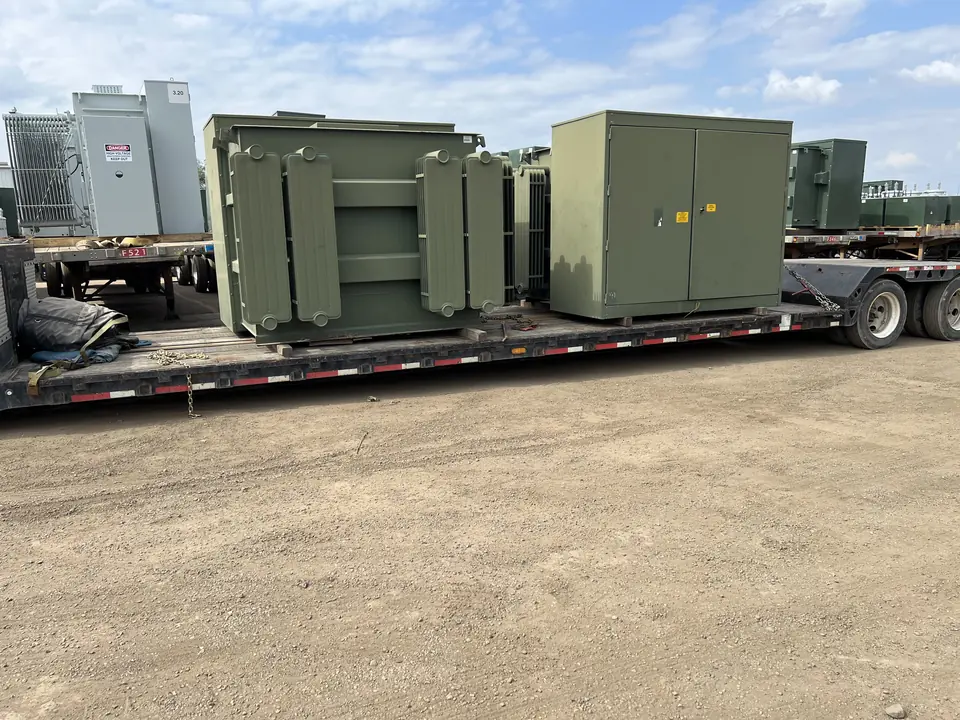
Padmount vs substation transformer basics
A pad-mounted transformer typically combines a transformer tank and enclosed cable compartments in a ground-level assembly. Its design suits locations where people may approach the equipment, provided it is properly installed, locked and maintained. A substation transformer is intended for an installation with controlled access, such as a fenced utility yard or an electrical room.
These categories overlap. A padmount can perform a secondary-substation function, while a substation transformer may connect directly to enclosed switchgear. The difference between a padmount and a substation transformer is therefore about construction and system arrangement, not a universal dividing line between small and large equipment.
- Check the actual enclosure and terminal arrangement rather than relying on a project nickname.
- Record the nameplate ratings before deciding whether another transformer is a suitable replacement.
- Identify whether the sale includes only the transformer or also connected switches, bus sections and switchgear.
Construction, enclosures and cable connections
Most familiar outdoor padmounts are liquid-filled units with separate high-voltage and low-voltage compartments. Their doors and barriers restrict access to energized components. Dead-front construction uses insulated, shielded connections rather than exposed high-voltage terminals; live-front designs have exposed terminals inside the secured compartment.
Substation transformers commonly have exposed bushings, cable boxes or enclosed throat connections that attach to adjacent equipment. A bushing is an insulated conductor passing through the tank or enclosure. The terminal layout determines cable routing, required clearances and whether the transformer fits an existing installation.
Substation equipment can be liquid-filled or dry-type. Dry-type transformers use solid insulation and air rather than an insulating liquid, so ventilation and installation requirements differ. The dry-type and oil-filled transformer comparison explains that distinction separately; padmount versus substation is not the same classification.
- Photograph both cable compartments, if safely accessible after isolation, and all external connection points.
- Note damaged doors, missing barriers, corroded hinges, cracked bushings and signs of liquid leakage.
- Measure the footprint and connection locations when replacement fit matters.
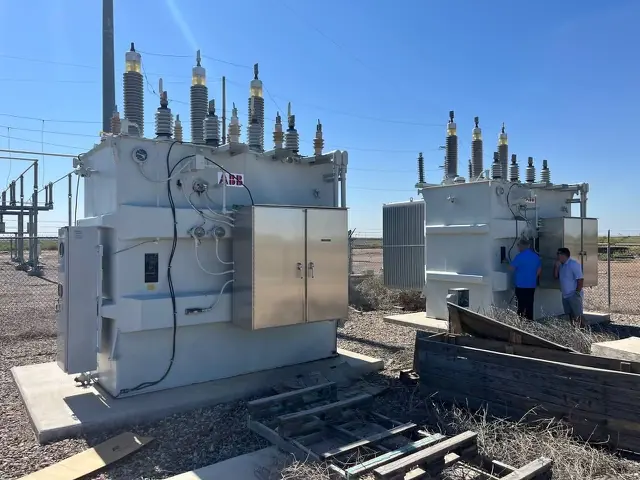
Typical capacity and voltage ranges
Capacity is stated in kVA, or kilovolt-amperes, and MVA, or megavolt-amperes; 1 MVA equals 1,000 kVA. Single-phase padmounts often serve loads in the tens to hundreds of kVA. Three-phase padmounts commonly range from several hundred kVA into several MVA, with larger designs available.
Secondary-substation transformers often range from several hundred kVA to several MVA. Larger utility and industrial power transformers can reach tens or hundreds of MVA. These are typical applications, not strict boundaries: capacity alone does not identify the construction type.
Padmounts commonly take medium-voltage service, such as 4.16, 12.47, 13.8 or 34.5 kV, and supply utilization voltages such as 208Y/120 or 480Y/277 V. Substation transformers cover those duties too, as well as higher-voltage service. Primary voltage is the input-side rating; secondary voltage is the output-side rating. Read both from the nameplate.
- Record phase count, frequency, primary and secondary voltage, and every listed capacity rating.
- Include winding connection and available tap settings, which allow voltage-ratio adjustment.
- Capture impedance: the transformer's internal opposition to current, expressed as a percentage, which affects fault current and parallel operation.
Where each transformer arrangement is used
Padmounts are common at commercial buildings, apartment developments, schools, industrial sites and underground utility distribution systems. Their enclosed connections allow ground-level installations without a conventional open substation yard. Installation still requires appropriate access, clearances and protection from vehicle impact.
Substation transformers serve manufacturing plants, refineries, large campuses, utility substations and other concentrated loads. They may sit inside a fenced yard or form part of a unit substation with primary equipment and secondary switchgear. A unit substation is an integrated assembly, not simply another name for a transformer.
For a secondary substation vs padmount comparison, first identify the function. Both may reduce medium voltage to a building's service voltage; the important distinction is how the transformer interfaces with protection, cables and distribution equipment. Keeping an assembly complete can matter when evaluating unit-substation equipment for sale.
- Identify who owns the transformer before arranging a sale; equipment on private property may belong to the utility.
- Check whether downstream switchgear depends on a specific bus throat or terminal orientation.
- Record access restrictions around occupied buildings, operating plants and fenced electrical yards.
Protection, switching and cooling accessories
A padmount may include internal fuses, switches and separable cable connectors, but features vary by design. Loop-feed equipment provides connections for incoming and outgoing distribution cables. That arrangement can support alternative supply routing, but it does not automatically mean the transformer has every switching feature required by the system.
Substation protection often relies on external breakers, relays and instrument transformers, alongside transformer-mounted devices. Liquid-filled units may have pressure-relief devices, liquid-level gauges and temperature indicators. Larger units can also have fans, pumps, conservators or on-load tap changers, which adjust voltage ratio while energized.
Cooling codes help explain multiple ratings. ONAN means oil natural, air natural: natural circulation of both oil and surrounding air. ONAF means oil natural, air forced, usually using fans. A higher fan-cooled rating depends on the specified cooling equipment being present and functional.
- List included fuses, switches, gauges, fans and control cabinets rather than assuming they are standard.
- Photograph accessory nameplates and note missing wiring, damaged controls or disconnected cooling equipment.
- Keep relay settings, wiring diagrams and operating records with the equipment when available.
Transport and installation differences
Padmounts often ship as complete assemblies, but their compact appearance can hide substantial weight. Shipping plans need verified weight, dimensions, lifting points and a route suitable for the load. Cable compartments, radiator surfaces and bushings should not be treated as lifting or tie-down points.
Larger substation transformers may require removal of radiators, bushings or other accessories for transport. That work needs an equipment-specific plan, including protection of openings and management of insulating liquid where applicable. A transformer that fits a trailer may still exceed axle limits or encounter clearance restrictions along the route.
Installation also differs: padmount cable bends and compartment access must fit the pad layout, while substation equipment may require precise alignment with bus connections or external conductors. Check the transformer shipping considerations in Texas before committing to a removal date.
- Confirm operating weight versus shipping weight and identify any separately shipped components.
- Document gate widths, overhead obstructions, ground conditions and crane or forklift access.
- Use qualified personnel to isolate, de-energize and disconnect equipment before load-out.
What affects value when the equipment is sold
In a padmount vs substation transformer comparison for resale, usable specifications matter more than the category label. Capacity, voltage ratio, winding arrangement, impedance and condition determine how closely a unit matches a prospective application. An unusual configuration can narrow the pool of potential users.
Complete, documented equipment is easier to evaluate than a unit with missing accessories or uncertain history. Recent electrical test reports and maintenance records can help establish condition. DGA, or dissolved gas analysis, examines gases in insulating liquid for signs of electrical or thermal problems; findings should be considered alongside other tests and operating history.
Failure history, flood exposure, leaks and physical damage also affect evaluation. PCB, or polychlorinated biphenyl, documentation may be relevant for older liquid-filled equipment. Provide existing records rather than assuming fluid status from age or appearance; the storm- and flood-damaged transformer guide covers additional condition details.
Removal costs matter as well. A readily accessible unit with clear specifications presents a different transaction from equipment requiring major dismantling or difficult rigging. For a pad mounted transformer vs substation sale, document these practical differences before comparing offers.
- Send a readable nameplate photo, overall views, quantity, location and an honest condition description.
- State whether the equipment is working, retired, failed, stored or new in its crate.
- Identify included accessories and supply available test reports, drawings and fluid records.
Get an offer for a transformer in Texas
Texas Transformer Buyers buys new surplus, used, retired and failed transformers statewide, including single units and whole lots of any brand. Equipment ranges from 10 kVA pole-mounts to large MVA substation and power transformers. Our base of operations is 6402 McGrew St, Houston, TX 77087.
Send your nameplate photo, overall photos, quantity, location and condition through the transformer offer form, by email to Industrial832@gmail.com, or by calling or texting (951) 403-5738. We review what you send and come back with an offer.
Price, payment terms and pickup details are agreed in writing before anything is loaded. You or your qualified electrical contractor must de-energize and disconnect the equipment; we coordinate trucking, pickup and load-out with you.
Frequently asked questions
Is a padmount always smaller than a substation transformer?
No. Their capacity ranges overlap, especially for three-phase distribution equipment. Compare nameplate ratings and physical dimensions rather than judging capacity from enclosure style.
Can a padmount replace a substation transformer?
Sometimes, but matching kVA and voltage is not enough. Connection layout, impedance, grounding, protection, clearances and cable routing need an engineering assessment before substitution.
Are all padmount transformers dead-front?
No. Both dead-front and live-front designs exist. Confirm the terminal arrangement from drawings or safe inspection of isolated equipment, not from the exterior enclosure alone.
Does loop-feed mean two transformers can operate in parallel?
No. Loop-feed describes distribution cable connections. Parallel operation requires compatible electrical characteristics and an engineered system arrangement; loop-feed construction alone does not establish compatibility.
Should attached switchgear stay with a transformer being sold?
Document the complete assembly before separating it. Matching switchgear, bus connections and drawings may help another facility use the equipment, although value depends on specifications and condition.
Can a failed transformer still be evaluated for sale?
Yes. Include the known failure symptoms, damage photos and any test findings. Clearly distinguish a confirmed fault from equipment that was simply removed from service without testing.