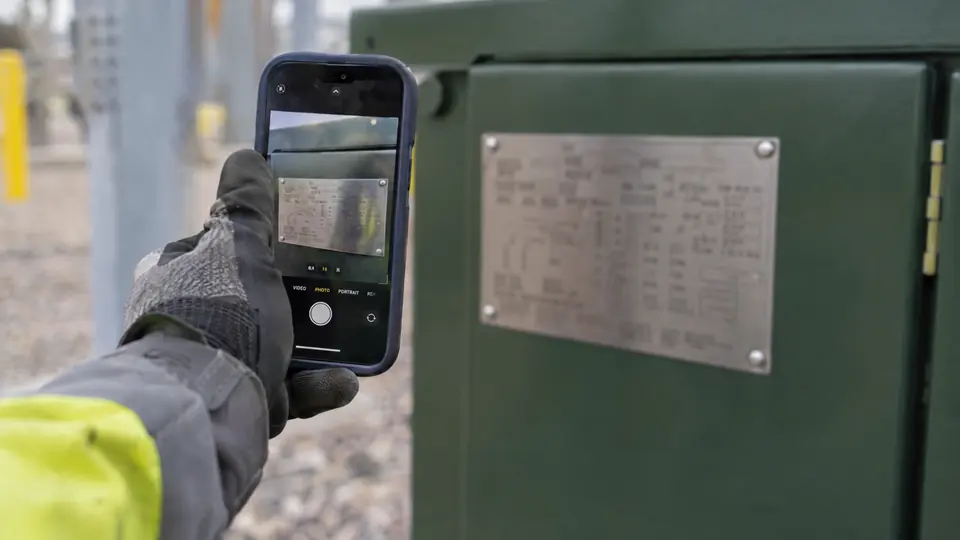
Start with a clear transformer nameplate photo
Take the nameplate straight-on, with the camera parallel to its surface. Get close enough for the lettering to be readable, but keep the entire plate in the frame. Tap to focus and check the saved image before moving on.
Avoid flash glare, harsh reflections and shadows across stamped numbers. If the plate is difficult to read, take one complete photo plus overlapping close-ups. Photograph separate accessory plates and replacement labels rather than assuming they repeat the main plate.
The key fields are manufacturer, serial number, kVA or MVA rating, primary and secondary voltage, phase, frequency and impedance. kVA and MVA describe transformer capacity; primary and secondary voltage identify the input and output ratings. Impedance is the percentage value describing the transformer's opposition to current, relevant to fault-current calculations and system compatibility.
- Include the wiring diagram, tap settings and manufacture date if shown.
- Capture cooling ratings such as ONAN/ONAF, meaning oil-natural/air-natural and oil-natural/air-forced cooling.
- Send the original-resolution image rather than a screenshot or a compressed collage.
- For a dry-type unit, include enclosure and insulation information shown on its labels.
Build a complete set of transformer photos for offer assessment
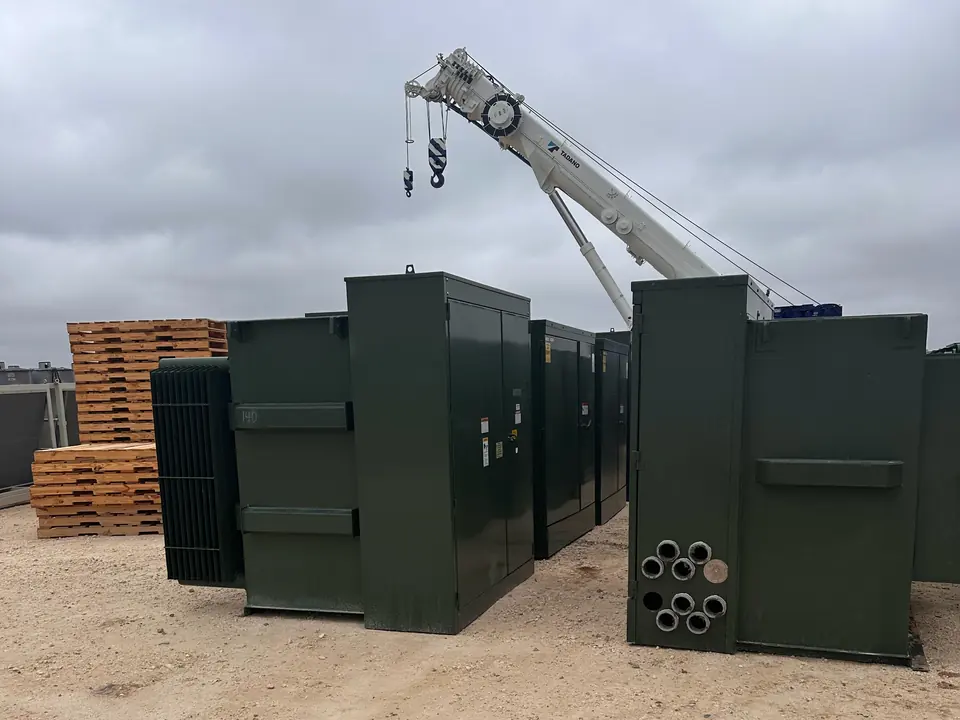
Photograph all four sides and the top when visible from a safe position. Each overall image should show the whole unit, including its base, cabinet, attached cooling equipment and connection areas. Leave enough background to make its orientation clear.
Use a consistent order around the equipment so the buyer can follow the set. For a unit against a wall or inside a crowded electrical room, explain which side is inaccessible. Do not climb equipment or use nearby electrical structures to get a top view.
An overall view also helps distinguish equipment arrangements. The guide to padmount and substation transformer differences can help identify which features to capture.
- Take a wide view of each accessible side, followed by closer views of important details.
- Show the base, skid, mounting feet, lifting lugs and any visible shipping brackets.
- For crated equipment, photograph the crate, shipping labels and visible condition without dismantling protective packaging.
Photograph HV and LV compartments only when safe
HV and LV mean high voltage and low voltage. Interior photos can show connection arrangements and missing components, but they are not a reason to open energized equipment. Have the seller's qualified electrical personnel determine whether access is safe under the site's procedures.
Only photograph inside compartments after equipment is de-energized, isolated and verified safe by qualified personnel. A closed switch or a dark indicator does not establish that a compartment is safe. If access is not approved, send exterior photos and state that interior views are unavailable.
When authorized access is available, capture one overall image of each compartment and close-ups of connections. For dead-front construction, which uses insulated, shielded cable connections, show elbows and their labels. For loop-feed equipment, which provides incoming and outgoing primary connections, show both connection groups.
- Include visible switches, fuse assemblies, terminal markings and cable connection areas.
- Identify missing elbows, covers, barriers or hardware without touching or repositioning components.
- Do not reach into compartments or remove guards solely to improve a picture.
Show bushings, gauges, radiators and visible damage
Take close-ups of bushings, the insulated components that carry conductors through the tank or enclosure. Include cracked porcelain, chipped insulation, damaged terminals and evidence of overheating. Pair each close-up with a wider picture showing where the defect is located.
For oil-filled equipment, photograph accessible oil-level, temperature and pressure gauges, plus radiators, valves and tank seams. Record visible gauge readings without operating controls. On dry-type equipment, show accessible coils, ventilation openings and signs of moisture or heat damage.
Photograph leaks as found, including the apparent source and any staining below it. Pictures cannot establish internal condition, so distinguish visible observations from known operating history. Use the dry-type and oil-filled comparison if you need help identifying the construction.
- Include dents, corrosion, broken doors, damaged hinges and missing panels.
- Report whether the unit was working when removed, failed in service or has an unknown history.
- Attach existing repair records or test results separately; do not describe an untested unit as tested.
Include PCB labels and available oil test reports
Photograph any non-PCB label so its wording and identifying details are readable. PCB means polychlorinated biphenyls, a group of chemicals historically used in some electrical insulating fluids. Also capture oil-type labels and records tied to the unit.
If an oil test report is available, send the complete document, including sample date, equipment identification, results and units. Make sure the report can be matched to the transformer's serial number or asset number. A label photo and a laboratory report provide different information; send both when available.
Do not assume PCB status from appearance, age or brand. State plainly when records are unavailable. The guide to PCB labels and transformer oil testing explains the documentation to look for.
- Include existing DGA reports if available; dissolved gas analysis measures gases in oil that can help assess internal faults.
- Keep documents grouped with the correct unit rather than attaching one report to an entire mixed lot.
Show site access and the route to the trailer
Take a wide photo showing where the transformer sits, then photograph the proposed route to a truck or trailer. Include gates, turns, loading areas and overhead obstructions. Mention soft ground, slopes, steps or trenches that may affect moving equipment.
Show whether the unit is on a pad, elevated platform, skid or indoor floor. Include the space around it so loading can be discussed realistically. Photos help explain access, but they do not replace actual measurements or a lifting plan.
If loading equipment is available, identify its type and rated capacity, along with who will operate it. Provide known transformer weight and dimensions from records or the nameplate; label estimates as estimates. Do not assume a forklift can lift the unit based on its physical size.
- Record gate width, doorway clearance and relevant height restrictions.
- Note whether a trailer can park beside the unit or must remain farther away.
- Show loading-equipment identification and capacity plates if available.
Add quantity, location ZIP code and removal timeline
Knowing what to send to sell a transformer means pairing the pictures with a short written inventory. Include quantity, location ZIP code, condition and your preferred removal window. Explain whether the equipment is already disconnected or is still part of an operating system.
For multiple units, assign simple identifiers such as Unit A and Unit B, and use them in filenames and notes. Provide a nameplate and overall views for each unit, even when several appear identical. Differences in voltage, condition or accessories can affect the assessment.
Include deadlines tied to demolition, lease turnover or project work, plus any appointment or site-entry requirements. A requested date gives the buyer planning context; it is not a confirmed pickup arrangement.
- State whether cables, bus connections, cabinets or accessories are included.
- Identify the contact responsible for equipment information and the contact coordinating site access.
- List known weight and dimensions separately for each different unit.
Organize the files before sending
To sell a transformer, pictures should be easy to match to the equipment and its records. Group files by unit, with the nameplate first, overall views next, then condition details and documents. Use short filenames such as Unit-A-nameplate or Unit-A-leak.
Check every image at full size before sending. Retake blurry labels, dark compartment views and cropped overall shots when safe access permits. Keep original files available if a messaging service reduces image quality.
Preparing transformer photos for offer assessment does not require polished photography. Readable identification, honest condition details and a clear loading picture matter more than an attractive background.
- Check that every listed unit has its own identification photo.
- Separate confirmed facts from estimates and unknowns.
- Add a short note explaining any missing view or unavailable record.
Send your checklist to Texas Transformer Buyers
Texas Transformer Buyers buys single units and whole lots, any brand, new in crate or used, working or failed. Equipment ranges from 10 kVA pole-mounts to large MVA substation and power transformers. See the transformer sizes we buy for capacity categories. Based at 6402 McGrew St, Houston, TX 77087, we buy statewide across Texas.
Send a nameplate photo, overall photos, quantity, location and condition through the transformer offer form, by text to (951) 403-5738 or by email to Industrial832@gmail.com. You can also call that number to discuss the equipment. We review what you send and come back with an offer.
We confirm the price, how payment is made and the pickup arrangements in writing before loading starts. The seller or the seller's qualified electrical contractor must de-energize and disconnect the equipment; we coordinate trucking, pickup and load-out with the seller.
Frequently asked questions
How many photos should I send?
Send enough to cover the nameplate, four sides, safely visible top, condition details and loading access. Add separate sets for each unit.
What if the nameplate is unreadable?
Send the best available photo plus close-ups, asset tags and existing equipment records. Explain which ratings remain unknown rather than guessing.
Do I need to open an energized transformer?
No. Exterior photos are the starting point. Interior images are only appropriate when qualified personnel have established safe access.
Should I clean up a leak before photographing it?
Document the condition as found when safe. Follow site procedures for managing the leak; do not hide it to improve the pictures.
Can I send photos of a failed transformer?
Yes. Include the failure history you know, visible damage and existing test records. State clearly if the cause of failure is unknown.
Can one nameplate photo cover several identical units?
Photograph each unit's nameplate. Similar enclosures can contain different ratings, and serial numbers help connect condition photos and records to the right equipment.